Wednesday, August 8, 2012

Cooking with Japanese Eggplant


Much like last year, the eggplant and tomatoes are doing well, but the cucumbers and zucchini are not.  I'll discuss the woes another time, but right now, we are enjoying the eggplant.  We're growing two varieties this year- Orient Express and Fairy Tale- after having great success with our first year of little Fairy Tales in 2011.  Both plants are looking great, and producing eggplant that needs to be picked every few days. 
Orient Express

Fairy Tale

For no good reason, I feel the need to use the Fairy Tale in Italian recipes, and I'm trying to experiment with the Orient Express in Asian fare.  Last night I pulled out a recipe a friend once gave me, from her Indian cooking class. 

Bengan Bharta

1 large eggplant (I used 2 Japanese)
1 onion, chopped
2 tomatoes, chopped
2 green chilies, diced (I removed half the seeds and ribs)
1/2" piece of ginger, minced (I was more generous)
2 cloves garlic, minced
1 Tablespoon chopped cilantro (I was more generous)
1 teaspoon red chili powder
1 Tablespoon dhana-jira power (1/2 cumin, 1/2 coriander)
1/8 teaspoon turmeric
2 teaspoons lemon juice
1 teaspoon salt
3 Tablespoons oil


The recipe calls for peeling the eggplant, but I didn't because the skins on the fresh picked eggplant are really tender.  I cut it into bite-size pieces, and steamed it for about 4 minutes, though you can roast it for a smokier flavor, and then mash it.

While you're cooking the eggplant, chop the vegetables.


Heat the oil in a frying pan.  When hot, add onions and green chiles. Stir for half a minute.  Add ginger and garlic and stir for 2-3 minutes.  Add tomatoes and half the cilantro and cook for one minute.  Add all the spices and mix well.

Add the eggplant and cook until it is completely heated through.  Sprinkle remaining cilantro on top.  It can be served with hot bread (someday I'd like to try making this homemade naan), as a dip, or I serve it with basmati rice.

I'm on the lookout for more eggplant recipes.  This won't be the last one you'll see.  If you have suggestions, send them my way!

P.S. I'm hoping we'll soon be able to cook with our own garden tomatoes alongside the eggplant.  The first is just starting to ripen.  These are "Big Boy" though they are not very big.

but there are plenty more of all colors and sizes, coming soon.
Black Cherry

Rosso Sicilian

Green Zebra

Monday, August 6, 2012

Hibiscus in Bloom

We split this plant from my in-laws last spring.  It's huge and very reliable with its gigantic flowers in August.

These flowers are bigger than my hand.

I was told it was a hibiscus, but I have no idea what kind.  I went online to try to identify it and some of the images I found of Swamp Mallow looked the same.  A lovely name. 


It seems there's two types of hibiscus we can grow here in Zone 6.  One is a shrub- Althea or Rose of Sharon- and the other is a hardy perennial that dies back to the ground every winter.  That's what we've got. 

The buds look like this

and the flowers last only a day or so before they fall off, but just as many are opening as the others drop.

 
What amazes me is how big it gets- approximately 6 feet by 6 feet- starting from scratch again every year. 

Swamp Mallow can also be called Rose Mallow, which I think I prefer.  More flattering, don't you think?

We've got a second plant near the lower vegetable garden, but it's more shaded and doesn't grow as big.  I think I'll move it to a sunnier spot for next year.

I hope you all had a beautiful weekend!

Wednesday, August 1, 2012

Saving Scallion Seeds

We were harvesting scallions all spring after they survived the mild winter. 

I kept them around until they formed seed pods, and when the flowers looked mature enough that I could see the little black seeds


I lopped off their heads.

They've been sitting in a paper bag on top of our refrigerator, drying out for several weeks.  After giving the bag a good shake, I could hear that lots of seeds had come loose.

And, now we're going to plant them, to harvest in the fall, and maybe through the winter and spring, if we're lucky.

I use scallions all the time and have hated to buy them at the store the last couple of months.  Now I realize that I should have planted more first thing in the spring to harvest throughout the summer.  And if we continue to let some go to seed, we'll never have to buy scallions, or scallion seeds again.  The best part is that insects and animals want nothing to do with them, and they don't need any fertilizing or pruning.  They just grow. Easy stuff!

Monday, July 30, 2012

The Garlic Harvest

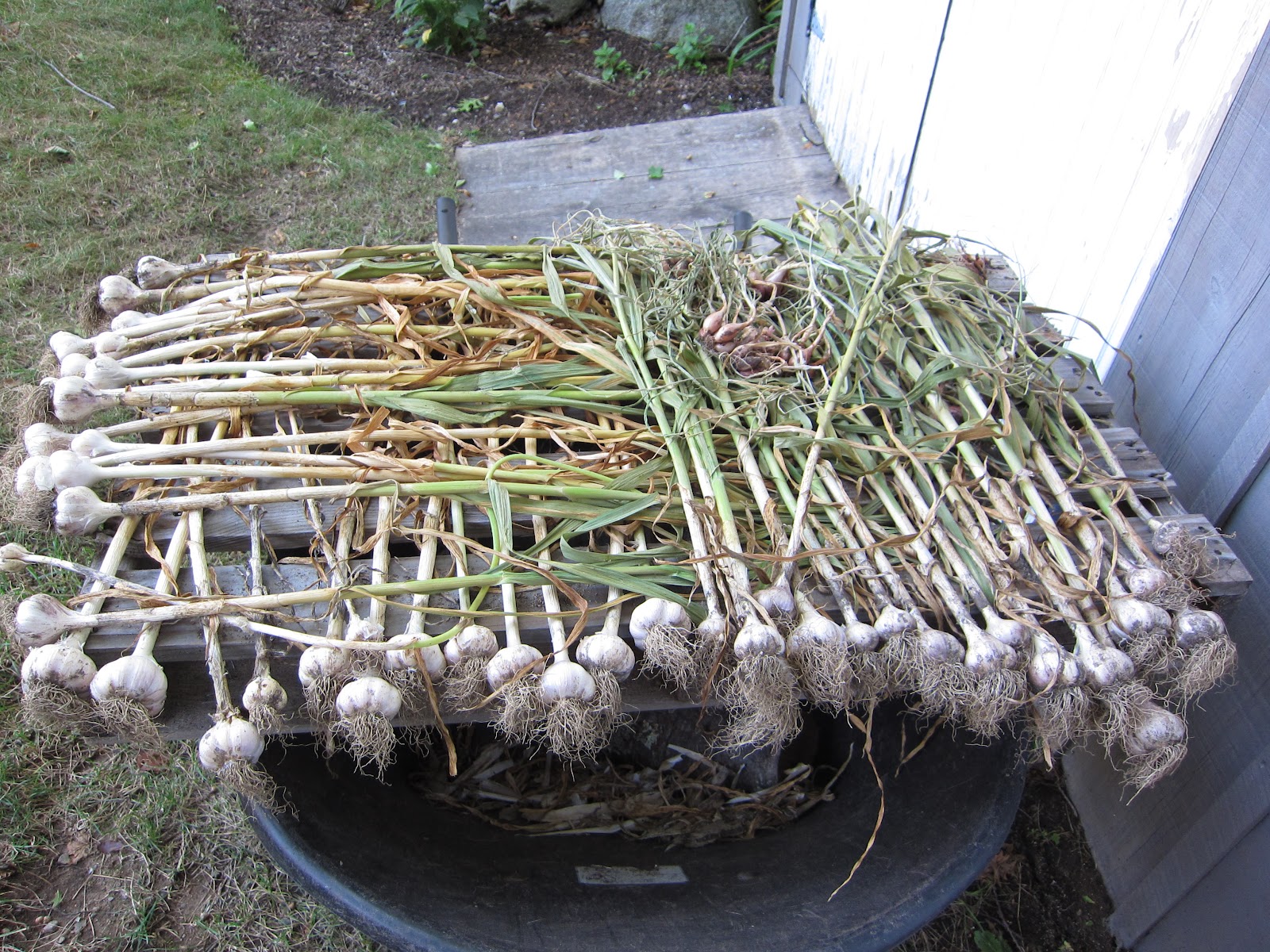
Half of our garlic looked like it should have been harvested weeks ago, but we finally got around to it last weekend, when it all looked ready.  You're supposed to harvest when the two bottom leaves start to look brown.  These were screaming to be pulled out of the ground.
Side note: When we harvested the garlic scapes, it looks like we missed one.  They're supposed to keep the bulbs from growing bigger, and this one (on the left, if it's not obvious) was in fact small compared to the best looking bulbs.  But there were a few other small ones, too, so it might have been doomed from the start for other undetermined reasons.
We planted three varietes last fall- German Extra Hardy, Persian Star, and Russian Red, but I can't tell which is which now.  Maybe next time we'll label them.

I read somewhere that someone (I can't find what I read now, of course) harvested garlic a few weeks ago and had the biggest bulbs ever after fertilizing them when they sprouted for the first time this year.  Some people say it's not necessary, but I think it'll be worth trying next year. 

The Vegetable Gardner's Bible says to remove the outer two leaves and cure the garlic in full sun for two to three weeks, but most other instructions say bright shade, where there's plenty of air circulation.  We've got ours on a pallet on a wheelbarrow so we can move it around, and we roll it into the shed when it's going to rain. 
A few weeks like this and then we'll trim them and store them in the basement (the coolest place we've got) in a mesh bag.  The hope is that, if properly cured, they will last for many months. Once they sprout, they start to loose their eating quality. 

Of course, we don't have to wait for the garlic to cure to enjoy it.  I've been using the smaller bulbs since we ran out of store-bought garlic last week.  Last night, we had shrimp scampi with fresh garlic and parsley from the garden.

Monday, June 25, 2012

Scrambled Eggs with Pancetta and Garlic Scapes

I love making a morning trip to the garden to snip something for breakfast.  This weekend we incorporated some garlic scapes into a usual Sunday meal at our house. 

Trader Joe's sells these 4-ounce packages of diced pancetta that are so convenient.  I often use them in soup or pasta dishes, but recently we realized that it's an easy way to add bacon to our breakfast without the mess.  We usually make this with scallions and red pepper, or whatever vegetables happen to be in the fridge, but garlic scapes made these eggs extra special.

Scrambled Eggs with Pancetta and Garlic Scapes
(serves 2)

4 eggs
salt and pepper
2 garlic scapes
one 4-ounce package of diced pancetta

The scapes get diced like so

and then sauteed in olive oil for a couple of minutes (just long enough to split the English muffins and put them in the toaster oven).

Add the eggs (already beaten and seasoned with salt and pepper),

and stir until cooked.

This is the time of year you'll find scapes at your local farmer's market, if you're not growing garlic at home.  With over 40 garlic plants in the garden, we'll use these a few more ways before we're done.  I think we've found that they are best in the simplest recipes, so you don't lose the subtle flavor.  Have you tried garlic scapes?  How do you like them?


Wednesday, June 20, 2012

Garden Update

I never photographed the tomato seedlings before they went in the ground Memorial Day weekend. You'll have to trust me when I tell you that they grew big and strong.  We had 24 plants, three varieties- a friend's heirloom, Black Cherry, and Brandywine- and we found homes (read: forced them on family members) for all but six.  We planted two of each variety, plus 7 more- Brandywine Sudduth, Big Boy, Gold Medal, Cherokee Purple, Green Zebra, Rosso Siciliano, and Mexican Midget.

They haven't been growing too fast because it's been rainy and cool, but here's one we grew from seed that's doing pretty well.  We're supposed to have a heat wave this week, so I expect they'll be doing a lot more growing soon.

See the new bed Matt dug for us? 

It's closer to the house and in a spot that gets full sun.  That's the "upper garden," and we're still utilizing the "lower garden," where the garlic and peas are nearing harvest time.

That's the garlic patch, and we picked some scapes for dinner.

The scapes need to be removed or the garlic bulbs won't grow as big.  They're good sauteed with olive oil and tossed with spaghetti.  The garlic will stay in the ground for about another month.

The peas (snow peas and a variety of English peas called Sutton's Harbinger), planted mid-April, have been flowering and developing pods for a few days now, right on schedule.  I expect we'll start picking some by the end of the week. 

This is our first year growing peas, and I'm actually amazed that it worked.  I haven't done much at all to them since we put the seeds in the ground, and here they are.  I shouldn't count my chickens before they hatch, I suppose.  They will not benefit from the heat wave as much as the tomatoes, but they do get some shade, and we'll keep them well watered.  Fingers crossed!

Monday, June 18, 2012

Bathroom Progress

I'm back!  I wouldn't blame anyone for assuming I'd given up this whole blogging thing, but I like it too much to do that.  It was a just a  temporary haitus- a few days turned into weeks, many weeks, and here we are, let it be noted, before it turned into months.  Things haven't stopped happening around here, so I'll try to fill you in as best I can.

The bathroom is coming along nicely.  The last update was just after the drywall had been put in. 

Then, Matt and his dad installed the shower and ceiling boards. 

We purchased a Schluter-Kerdi shower kit, and they followed the directions. I stayed out of the way, so my version of what happened goes a little like this: There's a shower pan and then a curb, and then everything has to be sealed with the orange Kerdi membrane.  It took them a couple of days to complete, and I didn't get the sense that it was their favorite part of the project so far. 

We used 1x8 tongue-and-groove pine on the ceiling, stained with Old Master's Pickling White. 


I had wanted them to be whiter, truth be told, but this is what we've got for now.  Initially I bought a wiping stain, and then I discovered the penetrating stain when I went to a different store to pick up a second quart.  Penetrating stain, well, penetrates, therefore you get a deeper color.  Each board got a coat of each, but they would have been whiter if we had used penetrating stain from the start.  Then they were sealed with two coats of matte polyurethane. 

The most significant development was the addition of tile.  This is when the bathroom really starts to look like a bathroom. 

We hired a couple of guys to do this, and it was worth every penny.  They worked for three days, while I made decisions about things I hadn't anticipated, like what color grout we wanted.  I was not aware that there were any choices, let alone so many.  So, here's what we've got:

3" hexagonal carrara marble on the shower floor, with silvertone sanded grout

Grazzio glass subway tiles in matte ice mist, with standard white grout

Serenissima Woodland tiles in Rovere on the bathroom floor, with sandstone beige grout


Yes, we went with tiles that look like wood.  I was amazed with the options, and could have written a whole blog post about them, if I had been on the ball at the time.  These looked rustic to us, and we liked them immediately.  It easily solved the problem that I was unwilling to compromise on wood, but that you can't lay real wood on top of a heat mat.  (And there was that concern that other people had about wood not holding up in a bathroom.)

After the tile was done, Matt and his dad installed the beadboard, and the plumber hooked up the shower fixtures, and the toilet.  The selection of beadboard could have been yet another blog post.  We wound up choosing 1x6 tongue-and-groove beadboard.  We liked that it was slightly wider and much more sturdy looking than the (of course) less expensive options. 

Now we don't have to go downstairs in the middle of the night.  But there's no sink yet, so we can't wash our hands.  Don't tell anyone. 

Ta da!  That is the bathroom so far.  Next up: the ceiling trim and the linen closet.  We have to wait another week for the shower door to arrive.  Matt's dad is working on building us a vanity this week.  And, I'm still on the hunt for a remnant piece of marble for the countertop.  Stay tuned for more soon.